For a child who didn't grow up speaking Czech, a maths test in a Czech school is really two tests at once: one in maths, one in language. Here is how combined Czech-and-maths tutoring works — and what foreign parents should know about the CERMAT entrance exams.
When maths becomes a language problem
Foreign parents are often puzzled: their child was good at maths back home, yet suddenly struggles in a Czech classroom. In most cases the maths hasn't gone anywhere — the language has moved in front of it. Terms like zlomek (fraction), obvod (perimeter) or slovní úloha (word problem) stand between the child and a problem they could otherwise solve.
There's a second catch: the Czech curriculum covers some topics in a different order than schools abroad. So a child may have genuinely skipped one chapter while repeating another. Neither is a crisis — but both need to be found and closed deliberately, not left to sort themselves out.
The CERMAT entrance exams, briefly
Admission to Czech secondary schools and gymnáziums (selective academic schools) is decided by the unified entrance exam (jednotná přijímací zkouška), prepared by the state organisation CERMAT. It has two parts: Czech language and literature and mathematics.
- Grade 9 → four-year secondary schools and gymnáziums
- Grade 7 → six-year gymnáziums
- Grade 5 → eight-year gymnáziums
Children previously educated abroad may be granted official accommodations for the Czech language test — the rules are specified each year, so always check the current conditions for your child's admission year. The maths test, however, applies to everyone. For children still mastering Czech, maths is usually where the points are won — which makes it the smartest place to build an advantage.
Our students receive our own CERMAT-style practice tests at no extra charge, plus A3 overview sheets for both Czech and maths — every rule and formula on a single page.
What combined tutoring looks like
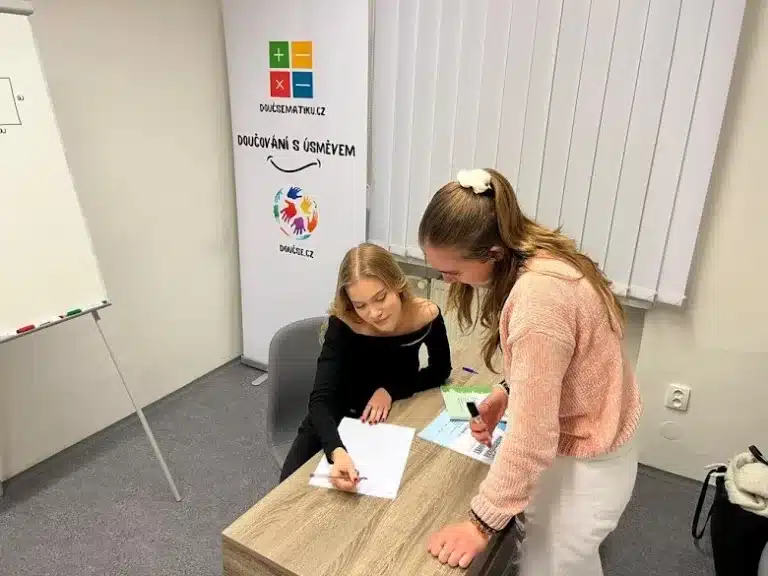
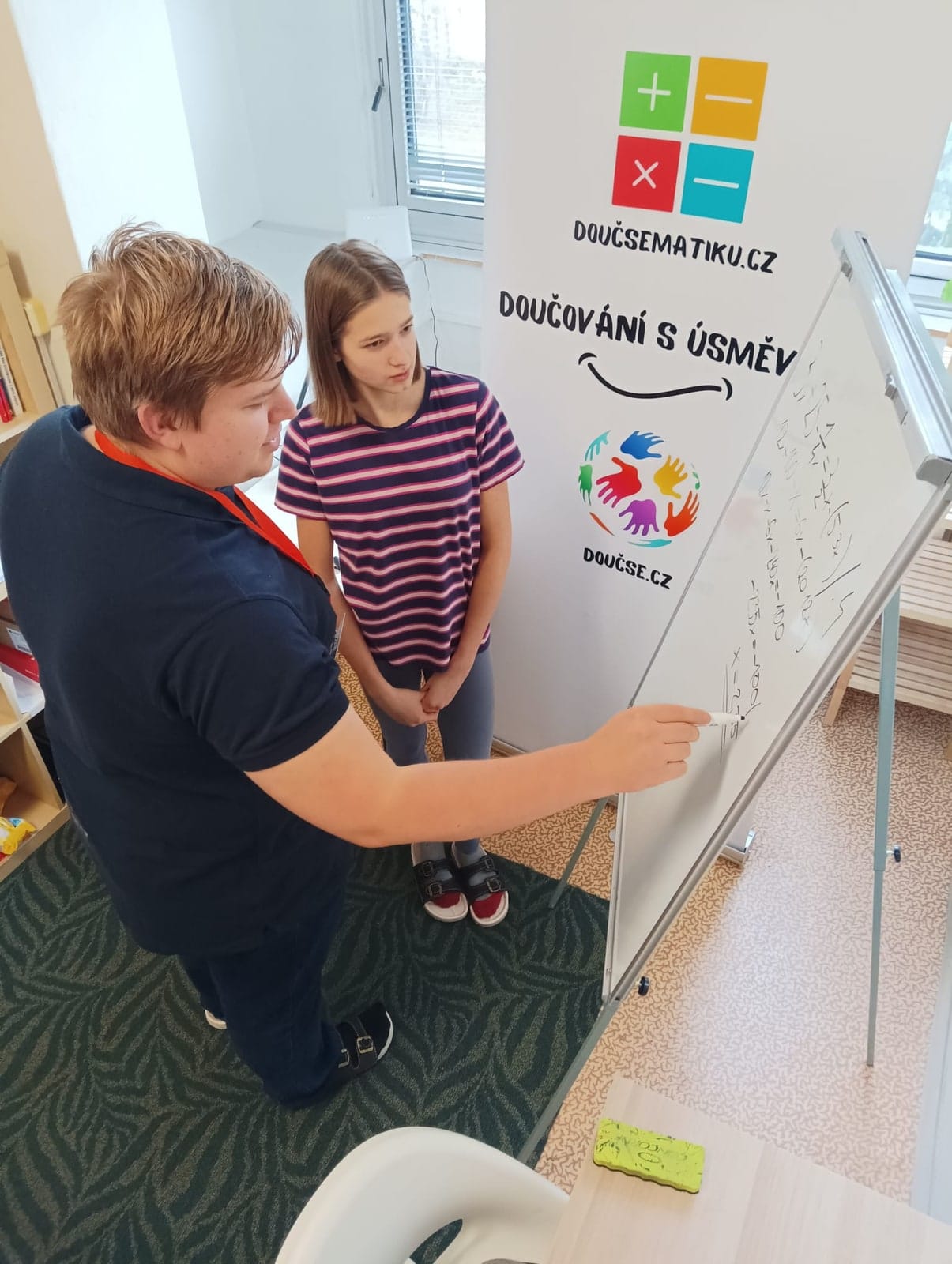
Rather than teaching Czech and maths separately, the tutor weaves them together: your child solves problems while picking up the exact Czech terminology they will hear in class and read in the test. At the beginning, explanations can be bilingual — when you sign up, tell us which languages your child speaks and we'll match a tutor accordingly.
Every child gets an individual plan. The tutor tracks what has been mastered, and after every lesson you receive short notes on what was covered and what to practise next. If a lesson doesn't work for your child, you don't pay for it.
For a broader look at how the Czech lessons themselves work, see Czech lessons for kids on our sister site doucse.cz.
The practical side
Lessons run online via Google Meet or in person in our classrooms in eight Czech cities. Booking and coordination work in English (Ukrainian and Russian too). One lesson package can be shared within the family — across siblings and subjects: Czech, maths, and other school subjects if needed.
Free help when a family needs it
If finances are tight, have a look at the Pomáháme programme — free or discounted lessons for families in a difficult situation, handled discreetly. You may also find these useful: our CERMAT preparation plan, school maths tutoring for English-speaking families and, in Czech, Czech for foreigners.
Frequently asked questions
What are the CERMAT entrance exams?
The unified state exams for admission to Czech secondary schools — two tests, Czech language and mathematics, taken in grade 9, and in grade 5 or 7 for multi-year gymnáziums.
Can Czech and maths be combined in one lesson?
Yes — that is how we usually work: solving problems while building the Czech vocabulary your child needs in class.
Do you provide practice tests?
Yes, our students get our own CERMAT-style practice tests at no extra charge.
What if we can't afford tutoring?
Get in touch anyway — the Pomáháme programme offers free or discounted lessons for families in need.
First steps
Write to info@doucse.cz or call +420 494 900 173 (Mon–Fri 9:00–19:00, Sat–Sun 14:00–18:00) — English is fine. Tell us your child's grade and what feels hardest — the language, the maths, or both — and a coordinator will come back within 24 hours with a plan and a tutor.